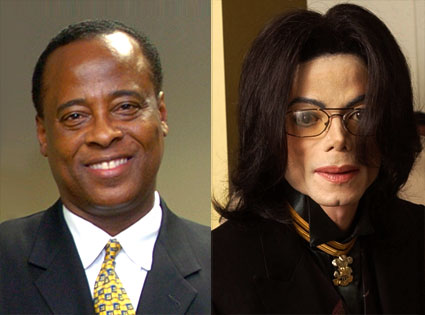
L.A. County coroner's officials found lethal levels of the powerful anesthetic propofol after examining Michael Jackson's body, according to a newly unsealed affidavit accompanying a search warrant unsealed today in Houston.
According to the search warrant, Jackson's doctor, Conrad Murray, told LAPD detectives that he had been treating Jackson for insomnia for about six weeks. He had been giving Jackson 50 milligrams of propofol every night using an intravenous line, according to the court records.
But Murray told detectives that he feared Jackson was forming an addiction and began trying to wean the pop star off the drugs. He lowered the dosage to 25 milligrams and mixed it with two other sedatives, lorazepam and midazolam. On June 23, two days before Jackson's death, he administered those two medications and withheld the propofol.
On the morning Jackson died, Murray tried to induce sleep without using propofol, according to the affidavit. He said he gave Jackson valium at 1:30 a.m. When that didn't work, he said, he injected lorazepam intravenously at 2 a.m. At 3 a.m., when Jackson was still awake, Murray administered midazolam.
Over the next few hours, Murray said he gave Jackson various drugs. Then at 10:40 a.m., Murray administered 25 milligrams of propofol after Jackson repeatedly demanded the drug, according to the court record.
Although Murray acknowledged to police that he administered Profofol, authorities said they could find no evidence that he had purchased, ordered or obtained the medication under his medical license or DEA tracking number. However, police detectives saw about eight bottles of Propofol in the house along with other vials and pills that had been prescribed to Jackson by Dr. Murray, Dr. Arnold Klein and Dr. Allan Metzger.
Other drugs that were confiscated in the search included Valium, Tamsulosin, Lorazepam, Temazepam, Clonazepam, Trazodone and Tizanidine. They also found Propofol in Murray’s medical bag. Murray told detectives that he was not the first doctor to administer the powerful anesthetic to Jackson.
Murray has already acknowledged obtaining and administering propofol to Jackson the morning that he died. In an interview with police, Murray told them that he left Jackson alone under the influence of the medication to make telephone calls to his Houston office and family members.
When he returned, he discovered Jackson was not breathing. He performed CPR, and one of Jackson’s staff members called 911. The 50-year-old pop star was rushed to the UCLA Medical Center, where he was later declared dead. Much of the investigation has focused on propofol — a drug typically administered by anesthesiologists during surgery — and whether Murray’s decision to give it to Jackson as a sleep aid outside a hospital setting reaches a level of negligence required for an involuntary manslaughter charge.